
Grove
Main menu key: e
External-module shelf: I2C (FM radio, NFC, bus scan) and UART (GPS; also Cap LoRa-1262 GNSS on Adv) on the left Grove / Cap bus. Up to 8 cards per page; number keys restart at 1 on the current page; letter shortcuts work from any page. ESC / GO returns a child to this shelf; press again on the shelf to return to the main menu.
This page covers wiring, behavior, and source APIs for chips the firmware already drives. Radio: Radio. NFC: NFC. GPS: GPS. Scan: I2C Scan. CC1101 driver code remains, but the shelf entry is hidden for now (unfinished).
Screenshots
Shelf
Children
| Key | Child | Bus | Chip | Role |
|---|---|---|---|---|
1 / r | RADIO | Grove I2C | TEA5767 / RDA5807M | FM, seek, station list; RDA also has volume / RDS |
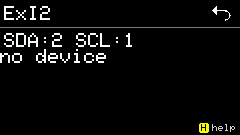
2 / e | EXI2 | Grove I2C | any ACK | List addresses with a likely chip name and role |
3 / n | NFC | Grove I2C | ST25R3916 (Unit NFC) | Read / write 13.56 MHz, NDEF / stored-card emulate, history |
4 / g | GPS | Grove UART or Cap UART | AT6668 (Unit / Cap LoRa GNSS) | Live / speed / sky / record; auto-detect source |
Shortcuts
| Key | Action |
|---|---|
1–8 | Open the child on the current page |
r / e / n / g | Jump to RADIO / EXI2 / NFC / GPS |
[ ] / arrows | Flip the shelf (when there are more than 8 items) |
ESC / GO | Child → shelf → main menu |
h | Help inside a child (the shelf has none) |
Hardware
Cardputer-ADV exposes two common expansion ports. This shelf groups them, but the protocols differ — do not mix 5 V onto a 3.3 V radio.
Left Grove (Ex_I2C)
HY2.0-4P rubber socket on the left with the screen facing you and the keyboard at the bottom. Firmware object: M5Cardputer.Ex_I2C. Related apps call Ex_I2C.begin() (boot only setPorts; without begin a Grove scan is empty).
| Order (top→bottom) | Pin | Role |
|---|---|---|
| 1 | GND | Ground |
| 2 | 5V | Power (for 5 V modules) |
| 3 | G2 | SDA |
| 4 | G1 | SCL |
Match FM modules by silkscreen SDA / SCL / VCC / GND, not by counting pins left-to-right. Audio comes from the module 3.5 mm jack, not the Cardputer speaker.
Fallback: if Grove has no FM chip, Radio retries M5Cardputer.In_I2C (EXT G8=SDA / G9=SCL).
Rear EXT14 (CC1101 SPI)
Shares SPI with microSD; chip-select is separate. Firmware uses FSPI with SPISettings(2 MHz, MSBFIRST, SPI_MODE0).
| Module pin | GPIO | Role |
|---|---|---|
| VCC | 3.3 V | 3.3 V only — never 5 V |
| GND | GND | Ground |
| CSN | G13 | Chip select |
| SCK | G40 | SPI clock |
| MOSI | G14 | Host out |
| MISO | G39 | Host in |
| GDO0 | G15 | RX/TX done IRQ |
| GDO2 | G5 | Optional carrier detect (wired; RST is NC) |
EXT14 5VIN / 5VOUT are 5 V — do not use them as CC1101 VCC.
Chips in this firmware
TEA5767 (FM)
| Item | Value |
|---|---|
| Bus | I2C address 0x60 |
| Port | Grove G2/G1 first, then In_I2C G8/G9 |
| Frequency unit | 0.01 MHz (9850 = 98.50 MHz) |
| Bands | Europe 87.50–108.00 MHz; Japan 76.00–91.00 MHz |
| Step | 0.10 MHz |
| Volume | No chip volume — use the headphone knob |
| Probe | scanID(0x60); writes a 5-byte register block |
| Source | include/tea5767.h, src/tea5767.cpp |
Features: tune, mute, force mono, soft mute, high-cut (HCC), stereo noise cancel (SNC), 50/75 µs de-emphasis, high/low-side injection (HLSI), hardware seek (SM/SUD/SSL), L/R channel mute, standby. Level ADC updates only after a register write; the UI periodically calls kickAdc().
RDA5807M (FM + RDS)
| Item | Value |
|---|---|
| Bus | I2C sequential 0x10, random 0x11 |
| Port | Same as TEA5767 |
| Frequency unit | 0.01 MHz |
| Bands | 87–108 / 76–91 / 76–108 / 65–76 / 50–76 MHz |
| Spacing | 25 / 50 / 100 / 200 kHz |
| Volume | Chip 0–15 |
| Probe | Read register 0x00; chip-ID high byte is 0x58 |
| Source | include/rda5807m.h, src/rda5807m.cpp |
Features: tune / hardware seek, mute, output high-Z, bass boost, soft mute, soft blend, AFC, RDS/RBDS (PS, RT, CT, AF), optional I2S. An I2C scan write-probe can wake the RF; afterwards silence() writes 0x02 = 0 (ENABLE off, audio high-Z).
FmTuner::begin() probes RDA first, then TEA. If both sit on the bus, RDA wins.
CC1101 (433 MHz Sub-GHz, shelf entry hidden)
Driver and EXT14 wiring remain, but the Grove shelf card is hidden (unfinished). Do not assume G13 / G15 are free for CC1101 while Cap LoRa GNSS is in use.
| Item | Value |
|---|---|
| Bus | SPI (not I2C), RadioLib |
| Port | EXT14, table above |
| Default frequency | 433.92 MHz |
| Range | 387.00–464.00 MHz, 0.25 MHz step |
| Modulation | begin(freq, 4.8 kbps, 4.8 kHz deviation, 58 kHz RX BW, 10 dBm, 32-bit preamble) |
| Source | include/app_cc1101.h, src/app_cc1101.cpp |
Features (code present): init / re-init, send test packet CP-<seq>, listen ~3 s, arrow keys change frequency, RSSI refresh every 500 ms. No chip → NOT FOUND. Leaving the App calls standby().
I2C scan map (guesses only)
Scan range 8–119 (0x08–0x77). Green dot = known map, gray = unknown (-- / unknown). The ExI2 table is a likely Grove / Unit match, not a driver list. External chips with real drivers are mainly the FM tuners, NFC, GPS (and the hidden CC1101).
| Address | Likely chip | Role |
|---|---|---|
0x10 / 0x11 | RDA5807M | radio |
0x18 | ES8311 | codec |
0x23 | BH1750 | light |
0x26 | MiniScale | weight |
0x29 | VL53L0X | ToF |
0x34 | TCA8418 | keyboard |
0x3C / 0x3D | SSD1306 | OLED |
0x41 | 8Encoder | encoder |
0x43 | 8Angle | angle |
0x44 | SHT3x | ENV |
0x48 | ADS1115 | ADC |
0x50 | EEPROM | memory |
0x51 | BM8563 | RTC |
0x57 | UnitUS | sonar |
0x5A | MLX90614 | NCIR |
0x5F | CardKB | keyboard |
0x60 | TEA5767 | radio |
0x61 | PbHub | hub |
0x68 / 0x69 | BMI270 | IMU |
0x70 | QMP6988 | ENV |
0x76 / 0x77 | BMP280 | ENV |
Onboard confirmed (Hardware Test → InI2): 0x18 ES8311, 0x34 TCA8418, 0x68 BMI270.
App APIs
Same enter / leave / update / handle convention as other apps; Help uses close* / is*HelpVisible.
app_ex_i2c (shelf)
void enterExI2cApp();
void leaveExI2cApp();
void updateExI2cApp();
void handleExI2cApp(const Keyboard_Class::KeysState& status);
bool handleExI2cBack();          // child → hub; false if already on hub
bool closeExI2cHelp();           // delegates Radio / scan / CC1101 / NFC / GPS Help
bool isExI2cHelpVisible();
bool isExI2cRadioActive();       // screenshot slug
bool isExI2cCc1101Active();
main.cpp calls handleExI2cBack() before leaving for the main menu. Leaving the shelf stops Radio, mutes any FM on the bus, and stands by CC1101 / NFC / GPS.
app_radio
void enterRadioApp();
void leaveRadioApp();
void silenceFmRadioOnBus(m5::I2C_Class& bus); // mute + standby after a scan probe
void updateRadioApp();
void handleRadioApp(const Keyboard_Class::KeysState& status);
bool closeRadioHelp();
bool closeRadioStations();
bool closeRadioSeek();
bool isRadioHelpVisible();
app_i2c_scan
void drawI2cScanApp(m5::I2C_Class& bus, const char* title, bool internal_bus);
void handleI2cScanApp(const String& key, m5::I2C_Class& bus,
                      const char* title, bool internal_bus);
bool closeI2cScanHelp(m5::I2C_Class& bus, const char* title, bool internal_bus);
bool isI2cScanHelpVisible();
void resetI2cScanHelp();
The Grove shelf passes M5Cardputer.Ex_I2C, "ExI2", false. Hardware Test InI2 / ExI2 share the same functions. drawI2cScanApp runs bus.scanID(found) then silenceFmRadioOnBus(bus).
app_cc1101
void enterCc1101App();
void leaveCc1101App();
void updateCc1101App();
void handleCc1101App(const Keyboard_Class::KeysState& status);
bool closeCc1101Help();
bool isCc1101HelpVisible();| Key | Action |
|---|---|
r | begin again at the current frequency |
t | Send CP-<seq> |
l | startReceive(), ~3 s timeout |
| Arrows | ±0.25 MHz |
h | Wiring / key Help |
Driver APIs
The Radio App talks to both FM chips through FmTuner; chip-specific extras still come from tea() / rda(). Frequencies are always 0.01 MHz.
FmTuner (include/fm_tuner.h)
bool begin(m5::I2C_Class& bus);          // RDA → TEA
void detach();
static void silenceIfPresent(m5::I2C_Class& bus);

Chip chip() const;                       // None / Tea5767 / Rda5807m
bool isRda() const;
const char* chipName() const;

uint16_t freqMin() const;
uint16_t freqMax() const;
uint16_t freqStep() const;
void setFrequency(uint16_t freq_centi, bool wait_settle = true);
bool readStatus(Status& out);            // RSSI scaled to 0–15
void refreshSignal();                    // TEA: kickAdc

void setMute(bool on);
void setMono(bool on);
void setStandby(bool on);
void startSearch(bool up);
void abortSearch();

Tea5767& tea();
Rda5807m& rda();Status: freq_centi, rssi (0–15), raw_rssi, quality, stereo, ready, band_limit, valid_station, rds_ready / rds_synced.
TEA-only setters (no register writes in RDA mode): setJapanBand, setDeemphasis75, setHighSideInjection, setSoftMute, setHighCut, setStereoNoiseCancel, setSeekStop, setChannelMute.
Tea5767
bool begin(m5::I2C_Class& bus);
bool probe() const;
bool silence(m5::I2C_Class& bus);

void setFrequency(uint16_t freq_centi, bool wait_settle = true);
uint16_t getFrequency();
bool readStatus(Status& out);
void kickAdc();
void startSearch(bool up);
void abortSearch();

void setMute(bool on);
void setMono(bool on);
void setSoftMute(bool on);
void setHighCut(bool on);
void setStereoNoiseCancel(bool on);
void setJapanBand(bool on);
void setDeemphasis75(bool on);
void setHighSideInjection(bool on);
void setSeekStop(SeekStop level);     // Low / Mid / High
void setChannelMute(ChannelMute ch);  // Off / Left / Right
void setStandby(bool on);
void setPort1(bool high);
void setPort2(bool high);
Rda5807m
bool begin(m5::I2C_Class& bus, bool reset = true);
bool probe(uint16_t* chip_id = nullptr);
bool initialize();
bool softReset();
bool silence(m5::I2C_Class& bus);
bool setStandby(bool standby);

bool setBand(Band band);
bool setSpacing(Spacing spacing);
bool setFrequency(uint16_t freq_centi, bool wait = true, uint32_t timeout_ms = 500);
bool startTune(uint16_t freq_centi);
bool pollTune(Status* status = nullptr);
bool startSeek(bool up);
bool abortSeek();
bool waitSeek(uint32_t timeout_ms = 5000, Status* status = nullptr);

bool setMute(bool mute);
bool setMono(bool mono);
bool setHighZ(bool high_z);
bool setVolume(uint8_t volume);          // 0–15
bool setBass(bool enabled);
bool setDeemphasis50(bool use_50us);
bool setSoftMute(bool enabled);
bool setSoftBlend(bool enabled);
bool setAfc(bool enabled);
bool setSeekThreshold(uint8_t threshold);
bool setSeekWrap(bool wrap);
bool setRds(bool enabled);
bool setRbds(bool enabled);
bool pollRds(RdsGroup* group = nullptr);

const char* programService() const;      // PS
const char* radioText() const;           // RT
uint16_t programId() const;              // PI
Diagnostics: readRegister / writeRegister only for public registers; writes limited to 0x02–0x08.
RadioLib CC1101
What this firmware actually calls (not the full RadioLib surface):
g_radio.begin(freq_mhz, 4.8f, 4.8f, 58.0f, 10, 32);
g_radio.setFrequency(freq_mhz);
g_radio.transmit(payload);
g_radio.startReceive();
g_radio.available();
g_radio.readData(buf, len);
g_radio.getRSSI();
g_radio.standby();
m5::I2C_Class
Globals: M5Cardputer.Ex_I2C, M5Cardputer.In_I2C. Scan and drivers both sit on this layer:
| Method | Use |
|---|---|
begin() | Init Grove / internal port |
isEnabled() | Whether init ran |
scanID(bool result[120]) / scanID(addr) | Full scan or single-address probe |
getSDA() / getSCL() | Current pins |
writeRegister* / readRegister* | Register access |
See api/M5Unified.md (I2C_Class) in the repo for the lower-level list.
Usage
- Main menu
eopens Grove. Warm-green cards:1RADIO,2EXI2,3NFC,4GPS (CC1101 entry hidden for now). - Radio: plug a ready-made 4-pin board into the left Grove (G2=SDA, G1=SCL); headphones into the module jack. No chip →
NO MOD. Keys: Radio. - Scan: open EXI2 after plugging a device, or Hardware Test
8.rrescans. Probing FM addresses may briefly unmute; the App mutes and standbys afterwards. - NFC: Unit NFC (ST25R3916) on the left Grove. See NFC.
- GPS: Grove AT6668 Unit, or Adv + Cap LoRa-1262 GNSS; auto-detect on enter. See GPS.
- Leaving a child or the whole shelf stops FM / NFC / GPS so ports are not left busy.