
Conway Life
Entry: main menu g → Games page 2, 2
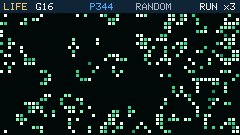
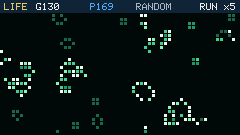
Conway's Game of Life on a 60 × 30 toroidal grid (edges wrap around), running the standard B3/S23 rules. Cells are coloured by age — near white when just born, dimmer the longer they survive — so movement and trails read at a glance.
Screenshots
Shortcuts
| Key | Action |
|---|---|
Space / GO | Run / pause |
n | Advance a single generation |
r | Random soup (~30% density) |
c | Clear |
1–6 | Load pattern: glider / glider gun / pulsar / LWSS / R-pentomino / acorn |
; , . / / arrows / EASD | Move the cursor (auto-pauses for editing) |
Enter | Toggle the cell under the cursor |
- = | Speed level 1–5 |
h | Help |
ESC / GO | Back to the game shelf |
Rules
Every generation updates at once, based only on how many of the 8 neighbours are alive:
| Now | Live neighbours | Next |
|---|---|---|
| Alive | < 2 | Dies (underpopulation) |
| Alive | 2 or 3 | Survives |
| Alive | > 3 | Dies (overcrowding) |
| Dead | = 3 | Born |
Built-in patterns
| Key | Pattern | Behaviour |
|---|---|---|
1 | GLIDER | Smallest spaceship, crawls diagonally |
2 | GUN | Gosper glider gun, period 30, emits gliders forever |
3 | PULSAR | Large period-3 oscillator |
4 | LWSS | Lightweight spaceship, flies horizontally |
5 | R-PENT | Five cells that take 1103 generations to settle |
6 | ACORN | Seven cells that explode into a thousand generations |
Notes
- The top bar shows generation
G, populationP, the current pattern name and the run state. - A fully static board is marked
STILL, a period-2 loopOSC, and an empty boardDEAD. Evolution stops automatically once still or dead. - Because the edges wrap, a glider leaving the right side comes back on the left, so patterns on a small grid usually end up interfering with themselves.